
Thailand’s Low Carbon Cities initiative is taking shape as a financing and carbon-market platform with opportunities for energy service providers, public authorities and corporate credit buyers. On 13 July 2026, the World Bank announced approval of the US$200 million Low Carbon Cities and Carbon Market Development Project. Its commercial significance lies in linking investment in cleaner public assets with a mechanism for aggregating and selling emission reductions.
For participants, the central legal question is what each transaction actually delivers: an energy service, a right to future credits, an issued credit, or permission to make a particular environmental claim. World Bank support, a certification pathway and a proposed exchange auction each serve different purposes. Together they provide a promising institutional framework, but the value of a particular credit still depends on its issuance, ownership, permitted use and contractual protections.
The financing and market structure
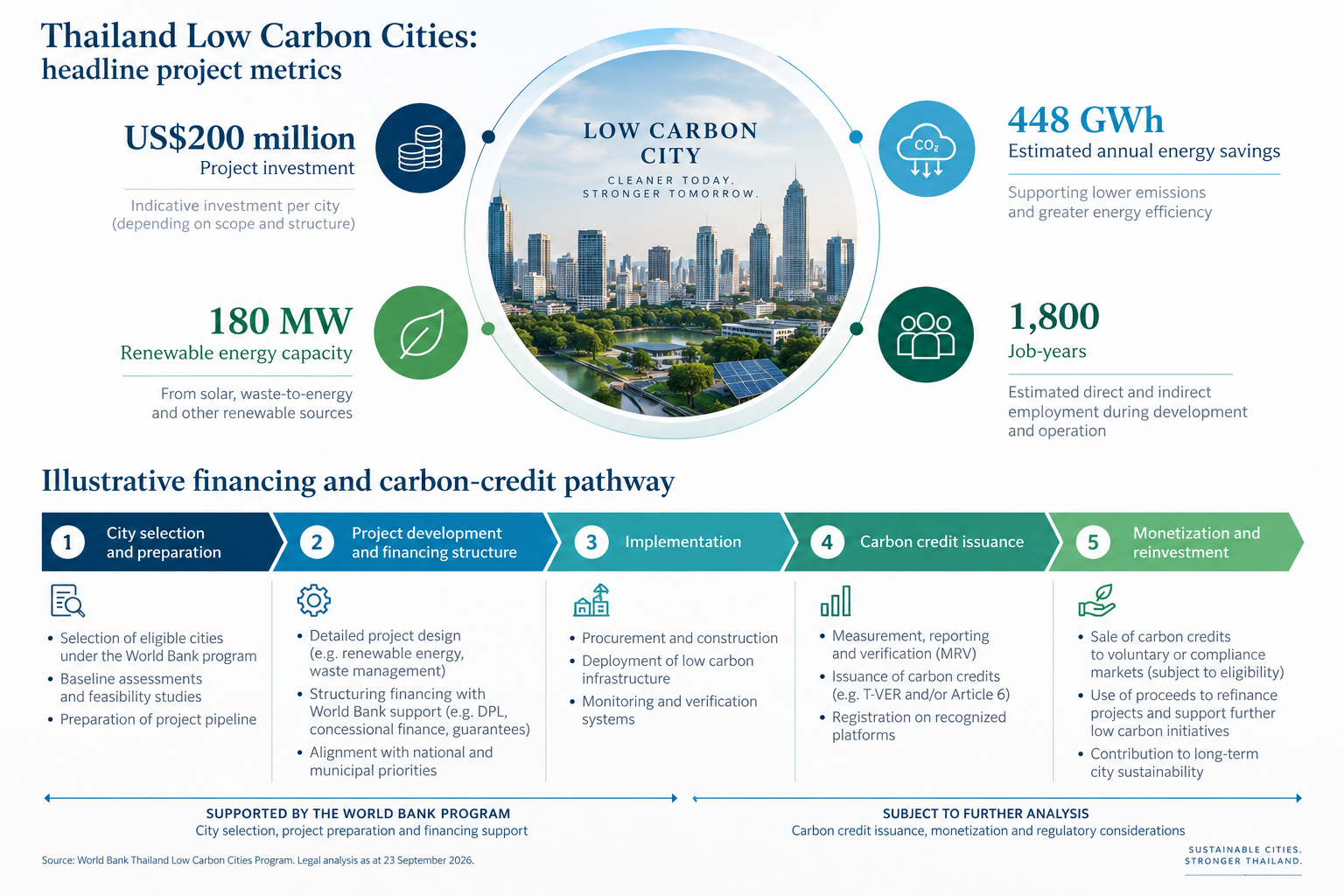
Under the announced model, the Export-Import Bank of Thailand will finance qualified energy service companies, commonly known as ESCOs, to upgrade assets of participating public organizations, initially the Bangkok Metropolitan Administration and the Industrial Estate Authority of Thailand. Public bodies pay for services over time. Krungthai Bank will aggregate credits and connect them with carbon markets. Expected outcomes include up to 180 megawatts of renewable capacity, approximately 448 gigawatt-hours of annual electricity savings and at least 1,800 job-years during implementation. These are projected outcomes; job-years measure employment over time rather than permanent positions.
The World Bank’s concept-stage project document explains the intended use of standardized performance contracts and digital measurement, reporting and verification. It is useful evidence of the model’s design, rather than a substitute for final procurement documents or executed agreements. For developers and lenders, the practical task is to confirm the public counterparty’s contracting authority, budget arrangements and payment obligations, together with site access, equipment ownership and remedies for underperformance. Savings calculations should specify the baseline, metering arrangements and adjustments for changes in occupancy or operating conditions.
Environmental and social obligations also affect eligibility and cost. EXIM’s published project management system requires screening, compliance with applicable Thai laws and permits, and contractual environmental and social commitments. Bidders should allow for these obligations in their delivery schedules and pricing, including worker safety, waste from replaced equipment and site supervision.
What Gold Standard status establishes
The reference to a gold standard has a verifiable institutional basis. Gold Standard’s registry identifies the Low Carbon Cities and Carbon Market Development Project as GS23612, developed by Krungthai Bank under Gold Standard for the Global Goals. On 23 September 2026, its record displayed “Listed” status, “No products issued” and no issuances. Associated activity records were also listed. Gold Standard’s published process distinguishes listing from design certification, performance certification and issuance. The accurate description is therefore a program pursuing the Gold Standard certification pathway; listing alone does not establish a supply of certified credits available for delivery.
Buyers should require the contract to identify the standard, methodology, relevant project or activity, crediting period and vintage—the period in which the reduction occurred. Delivery evidence should include registry identifiers and the applicable verification and issuance records. If contracting before issuance, the agreement should state whether the seller promises a fixed quantity or only the credits actually generated, and who bears delay, shortfall and certification risk. The agreement should also allocate the risk of subsequent credit invalidation, cancellation or failure to meet promised eligibility, including any replacement or refund obligation.
Additionality merits particular attention in renewable-energy and efficiency projects: the reduction must satisfy the applicable test for what would happen without the carbon-credit incentive. The Integrity Council for the Voluntary Carbon Market treats this as a substantive methodological assessment. Public financing or energy savings do not resolve that assessment by themselves. Technical diligence should examine the approved baseline, eligibility rules and supporting evidence rather than infer integrity from the technology or the standing of the institutions involved.
Ownership and environmental claims
A financing contract, an energy service contract and a credit purchase agreement can allocate different rights. The asset owner, ESCO, financier and aggregator should establish who may register the activity, obtain credits, transfer them and receive sale proceeds. Agreements should address competing assignments or security interests, registry control, fees and the allocation of revenue. A lender’s security over equipment should not be assumed to settle entitlement to environmental attributes.
Renewable Energy Certificates, or RECs, require separate attention. As a concrete example, the Thailand Greenhouse Gas Management Organization’s Premium T-VER rules prohibit carbon-credit issuance for renewable-electricity activity covering the same period for which RECs have been issued. Premium T-VER is distinct from Gold Standard, so that rule should not simply be imported into every LCC transaction. It illustrates why the applicable standard’s rules on overlapping certificates must be checked before parties promise both REC and carbon-credit revenues from the same activity.
The buyer’s intended claim should be agreed just as carefully as title. Under the GHG Protocol’s Scope 2 Guidance, an offset credit does not confer electricity-use attributes, and purchases of offsets are reported outside the corporate emissions scopes. Purchasing LCC credits therefore does not, by itself, establish that the buyer’s electricity is renewable or reduce its reported Scope 2 inventory. Contracts should specify who retires the credits, for whose benefit and with what evidence. Public statements should distinguish support for the program from verified reductions already delivered and validly claimed.
International use and the proposed auction
Internationally recognized certification and authorization for international use are separate questions. Thailand’s International Carbon Credit Guideline, approved by the Cabinet on 26 August 2025, addresses transfers for defined international objectives, including use towards another country’s mitigation target. It provides for authorization through the Department of Climate Change and Environment, transfer procedures and corresponding adjustments. Article 6.2 projects must operate under a cooperation agreement between participating countries. A corresponding adjustment is the national accounting treatment used to prevent double counting between Thailand’s national mitigation account and the authorized international use of the same mitigation outcome.
A foreign private buyer’s involvement does not alone determine whether that framework applies. The proposed use, relevant international mechanism and authorization terms must be examined. Where a buyer needs authorized units, the purchase agreement should make the necessary approvals and evidence contractual requirements, allocate responsibility for obtaining them, and address refusal, delay or changes in authorization. Gold Standard listing and World Bank participation do not establish those approvals.
The World Bank and Ministry of Finance anchor-buyer brochure describes a future SET auction and an indicative price range of US$12–15 per tonne of carbon dioxide equivalent. SET’s 2025 One Report separately describes the development of an LCC voluntary-credit auction system, with a planned launch in the third quarter of 2026. A development timetable and indicative pricing are not evidence of a completed auction, a binding quotation or a guaranteed market price. Prospective bidders need the actual auction notice and rules, including eligible units, delivery timing, bidder requirements, settlement, fees and default remedies.
The wider regulatory context also remains relevant. The World Bank’s carbon-pricing dashboard describes Thailand’s emissions trading system as under consideration, linked to the draft Climate Change Act. Participants should avoid valuing voluntary LCC credits on an assumption that they will be accepted under a future compulsory scheme. A contract can allocate the consequences of a regulatory change; it cannot confer eligibility that the future rules do not provide.
Participation and the terms that matter
The anchor-buyer materials envisage recognition of participating companies during an LCC showcase in connection with the World Bank–IMF Annual Meetings, scheduled for 12–18 October 2026 in Bangkok. The participation framework contemplates a non-binding Statement of Intent. Companies considering participation should nevertheless review the document carefully, as the legal effect of any statement will depend on its wording and the applicable law. Particular attention should be given to whether provisions concerning confidentiality, publicity, exclusivity, costs, intellectual property or dispute resolution are intended to be binding, even where any future commitment to purchase carbon credits is expressly stated to be non-binding.
Recognition as an early supporter should be documented separately from any commitment to purchase credits. A participating company should retain appropriate control over the use of its name and logo, the description of its involvement and any statements concerning environmental or climate impact. Participation in the program should not, by itself, be presented as evidence of certified emissions reductions or as an endorsement of the company’s broader climate performance.
Before entering into a binding carbon-credit purchase commitment, a prospective buyer should address four principal matters: the precise credits being acquired and their permitted use; the seller’s title to the credits and its delivery obligations; the evidence required for issuance, transfer and retirement; and the remedies available if those requirements are not satisfied. Developers should, in turn, ensure that these obligations are aligned with their financing, implementation and energy-service arrangements so that one agreement does not promise rights, volumes or delivery dates that another agreement cannot support.
The LCC program provides a potential mechanism for financing dispersed energy improvements and bringing the resulting carbon value to market. Its long-term effectiveness will depend on the connection between measurable project performance, credible certification and appropriately structured contractual arrangements. For businesses considering participation, establishing that connection is important both to the legal robustness of the investment and to the credibility of any associated public claims.
Companies seeking legal guidance on participation, contractual structuring or carbon-credit transactions in connection with the LCC program may contact Mahanakorn Partners Group at [email protected]