
Thailand is moving toward substantially closer supervision of stablecoin and digital-asset transfers. The emerging framework does not prohibit stablecoins such as USDT or USDC. Instead, it seeks to make transactions conducted through licensed Thai digital asset business operators more traceable, restrict transfers involving third-party wallets and subject transaction values to closer scrutiny against each customer’s financial profile.
Regulatory Status
Two related regulatory developments must be distinguished. First, the Securities and Exchange Commission of Thailand (SEC) has issued a broader Travel Rule for digital-asset transfers. Notification of the Office of the SEC No. Sor Thor. 9/2569 (2026), dated 25 August 2026, will take effect on 27 February 2027. Second, the SEC Board has approved principles for additional stablecoin-specific controls, but those measures remain proposals. The SEC opened a public consultation on 11 September 2026, with comments due by 25 September 2026. Their final wording, commencement date and transitional arrangements may therefore change.
The SEC had previously indicated that relevant stablecoin regulations were expected by the end of 2026. That remains an indicative policy target rather than a legally binding effective date. Businesses should therefore distinguish provisions already issued under the Travel Rule from stablecoin controls that are still passing through the rule-making process.
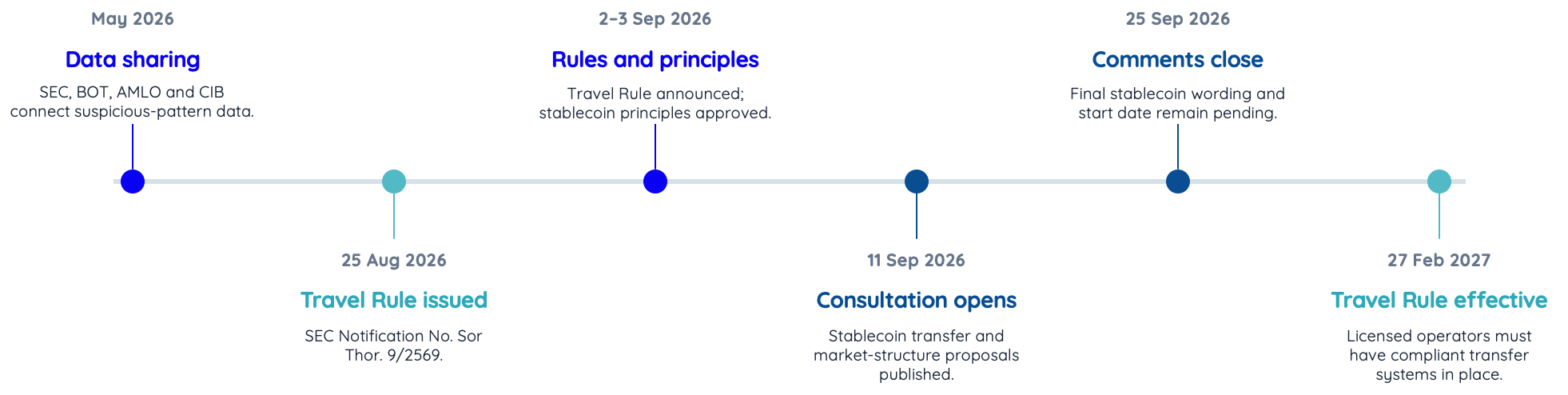
Figure 1. Timeline of Thailand’s stablecoin and digital-asset regulatory developments, including issuance of the Travel Rule, the stablecoin consultation and the Travel Rule’s effective date of 27 February 2027.
Why Stablecoins Are Under Closer Scrutiny
The regulatory initiative follows an increase in stablecoin transaction volumes, particularly transactions involving USDT, and the identification of transaction patterns that the SEC considers potentially associated with money laundering, technology-related crime and the circumvention of international fund-transfer controls. Stablecoins can transfer value quickly between platforms and jurisdictions while avoiding the price volatility commonly associated with other cryptocurrencies. Those same characteristics may make the movement and beneficial ownership of funds more difficult to establish where digital wallets, intermediaries and cross-border service providers are involved.
Since May 2026, the SEC, Bank of Thailand, Anti-Money Laundering Office and Central Investigation Bureau have been connecting financial information and suspicious transaction patterns. Existing supervisory measures include enhanced customer identification, customer profiling, additional checks for higher-risk customers, screening for mule accounts and high-risk wallets, blockchain analytics and transaction-monitoring tools. The proposed stablecoin rules would convert parts of this risk-based approach into more specific transfer restrictions.
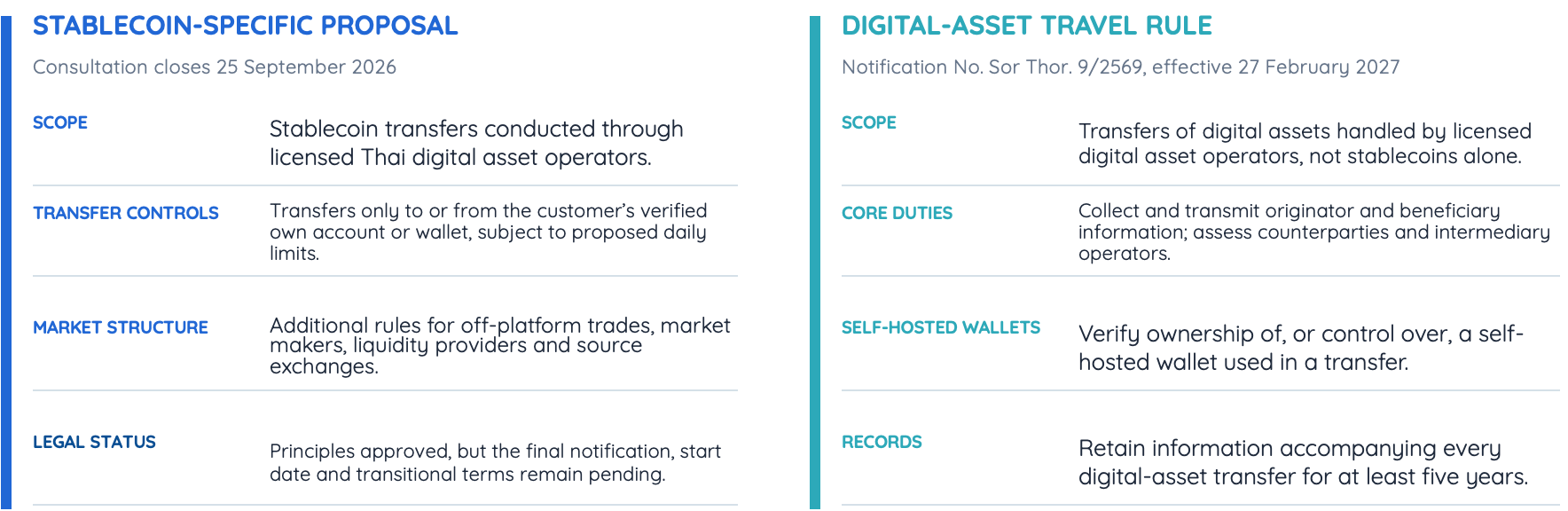
Figure 2. Comparison of the proposed stablecoin-specific controls and the issued Digital-Asset Travel Rule, including their respective scope, principal requirements and legal status.
Proposed Stablecoin Transfer Controls
Under the SEC’s proposal, a customer could transfer stablecoins into an account maintained with a licensed digital asset operator only from an account or wallet verified as belonging to that same customer. A withdrawal could similarly be made only to the customer’s own verified account or wallet. Deposits from another person’s wallet and withdrawals to another person’s wallet would be prohibited through the operator.
The originating and destination accounts or wallets would also have to satisfy Travel Rule requirements. Operators would be expected to profile customers, screen persons and wallets against mule-account and risk indicators, and use blockchain analytics to identify links to high-risk or watchlisted wallets.
The proposal would separately limit inbound and outbound stablecoin transfers to THB 5 million per customer, per day and per digital asset operator. The value transferred would also need to be consistent with the customer’s source of income and financial position. The inbound and outbound limits would operate separately rather than as a single combined daily allowance.
The THB 5 million limit would not apply to transfers between the customer’s accounts held with Thai digital asset operators where both the originating and receiving operators comply with the Travel Rule. Proposed exemptions would also cover specified digital asset operators transferring stablecoins through accounts held in their own names, Bank of Thailand-supervised businesses authorized to use stablecoins under an approved model, and certain market makers providing liquidity for stablecoin and Thai-baht trading pairs.
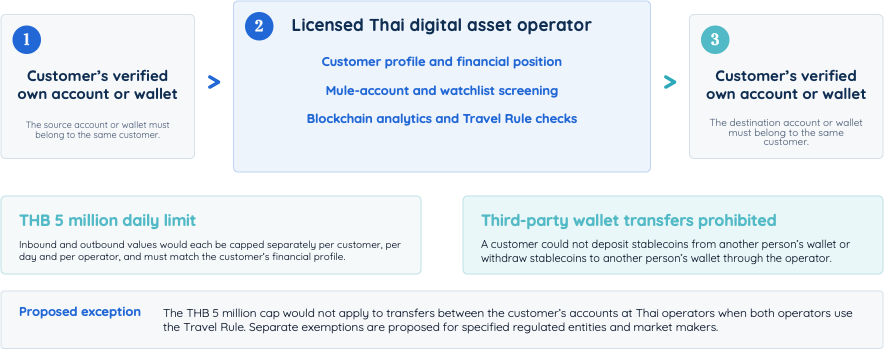
Figure 3. Proposed stablecoin transfer model through licensed Thai digital asset operators, including verified same-customer accounts or wallets, proposed daily transfer limits and specified exceptions.
Changes to Market Structure
The consultation extends beyond customer wallet transfers. For off-platform transactions conducted by digital asset brokers and dealers, the SEC proposes a minimum transaction value of THB 3 million and public disclosure of trading prices. Brokers would be prohibited from arranging direct off-platform trades between customers, although they could facilitate matching through a digital asset exchange.
Digital asset exchanges would also have to disclose the identities of their market makers and the assets for which liquidity is provided. They would be required to examine the source of assets used by market makers and the underlying purposes of their transactions.
Digital asset brokers would be prohibited from using liquidity providers for stablecoin and Thai-baht trading pairs. Other liquidity providers and source exchanges would have to operate in appropriately regulated jurisdictions, maintain suitable anti-money laundering controls and undergo continuing screening and monitoring. Brokers would also have to disclose liquidity providers and relevant conflicts of interest to customers.
The Digital-Asset Travel Rule
The Travel Rule is broader than the stablecoin proposal and applies to digital-asset transfers handled by licensed operators. Operators must establish transfer-risk policies, collect information concerning customers and their counterparties, conduct counterparty due diligence and assess the qualifications of counterparties, intermediary operators and other digital-asset service providers involved in the transfer route.
Where a transfer involves a self-hosted wallet, the operator must verify ownership of, or control over, that wallet. An originating operator must transmit the required originator and beneficiary information to the receiving operator together with the transfer instruction. Information accompanying each digital-asset transfer must be retained for at least five years in a form accessible to the supervisory authority.
The SEC has described these requirements as interim measures coordinated with the Anti-Money Laundering Office while the latter prepares regulations under the Anti-Money Laundering Act. The framework reflects the Financial Action Task Force standard, under which virtual-asset service providers obtain, retain and securely transmit originator and beneficiary information.
Implications for Licensed Operators
Licensed operators will need more than revised customer-facing terms. Implementation is likely to require interoperable systems for transmitting Travel Rule information, defensible methods for proving ownership or control of self-hosted wallets, enhanced counterparty due diligence and automated controls capable of applying customer-specific transfer limits across multiple channels.
Operators should also review their transaction-monitoring rules, source-of-funds procedures, wallet-screening technology, record-retention arrangements and escalation processes for rejected or suspended transfers. The increased collection and transmission of customer and counterparty information will require corresponding attention to privacy, cybersecurity, access controls and cross-border data arrangements.
Market makers, brokers, dealers and exchanges should separately review their liquidity arrangements, source exchanges, off-platform transaction procedures, price-disclosure mechanisms and conflicts documentation.
Implications for Businesses Using Stablecoins
Companies using stablecoins for payments, treasury management or cross-border settlements should map each transaction route carefully. A payment model that relies on withdrawing stablecoins directly from a Thai operator to a supplier’s, customer’s or employee’s wallet could become unavailable if the stablecoin proposal is adopted in its current form.
Businesses may need to route transfers through wallets demonstrably owned or controlled by the company, maintain stronger evidence concerning their financial position and source of funds, and plan around the proposed daily limits. Contractual payment provisions should also allow for compliance reviews, delays, rejected transfers and alternative settlement methods.
The proposal is not a blanket prohibition on holding or trading stablecoins, nor does it impose a general cap on every blockchain transaction. Its immediate scope concerns stablecoin transfers conducted through licensed Thai digital asset operators. Nevertheless, the direction of policy is clear: stablecoin activity connected to Thailand’s regulated market is moving closer to the identification, monitoring and recordkeeping expectations applied to conventional financial transfers.
Recommended Immediate Actions
Digital asset operators should complete a gap assessment against Notification No. Sor Thor. 9/2569, establish a work plan for the 27 February 2027 implementation date and assess the systems needed if the stablecoin proposals are adopted. Businesses using stablecoins should document their current wallet structure, transaction values, payment recipients and cross-border flows. Interested parties should also consider submitting comments to the SEC before the consultation closes on 25 September 2026.
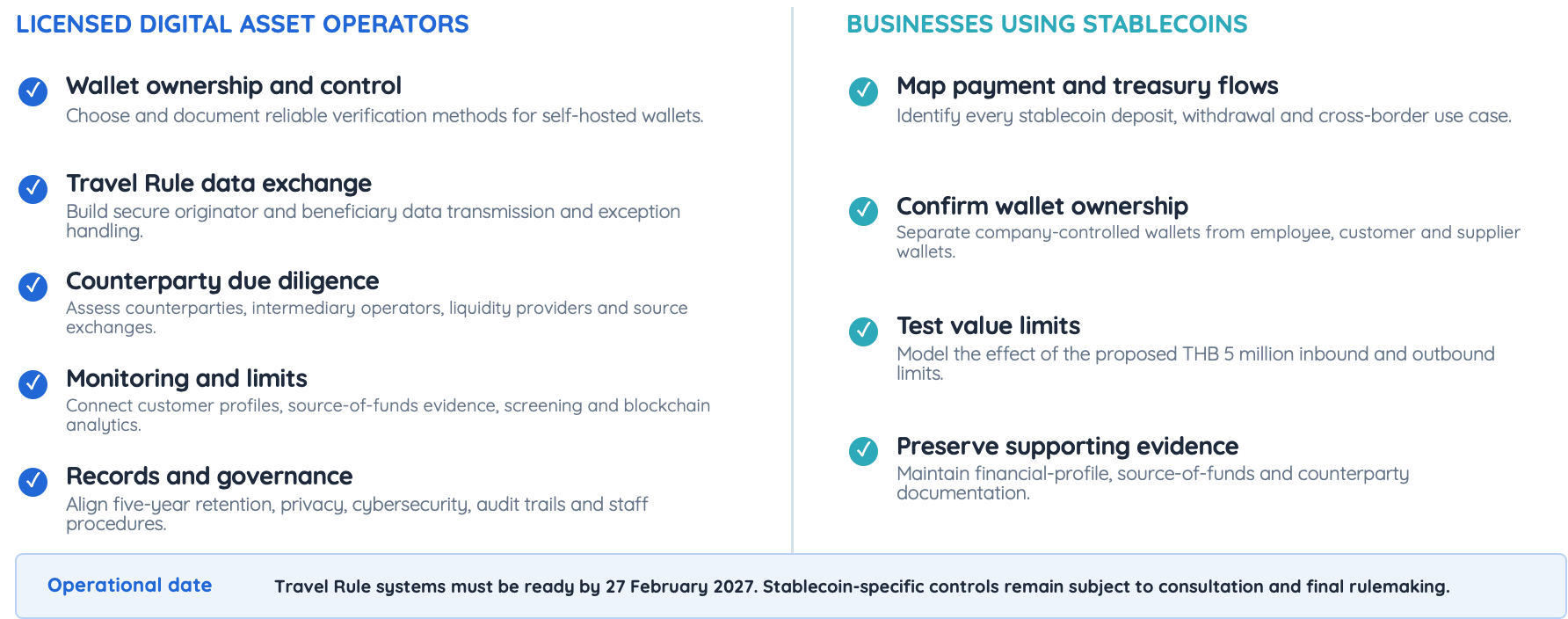
Figure 4. Compliance priorities for licensed digital asset operators and businesses using stablecoins in preparation for the Travel Rule and the proposed stablecoin-specific controls.
How MPG Can Assist
Mahanakorn Partners Group advises digital asset operators, fintech businesses, investors and corporate users on Thailand’s digital-asset, payment, anti-money laundering and data-protection requirements. MPG can assist with regulatory impact assessments, licensing and structuring advice, Travel Rule implementation, customer and counterparty procedures, wallet and transaction-control policies, contractual documentation, regulatory consultations and engagement with the relevant Thai authorities.
This article is provided for general informational purposes only and does not constitute legal, tax, financial or professional advice. The stablecoin-specific measures discussed above remain under consultation as of 16 September 2026. Advice should be obtained on the final regulations and the reader’s particular circumstances before any action is taken.