
Thailand’s Securities and Exchange Commission (SEC) has clarified how the country’s securities regulatory framework applies to family offices through Circular Letter No. KorLorTor. NorJor. (Wor) 47/2569, dated 9 September 2026, concerning the promotion and supervision of family-office businesses. The circular provides greater certainty for families organizing their wealth and for professional advisers developing services around investment coordination, succession and family governance. Its approach centers on the activities performed, the clients served and the manner in which services are offered.
A family office can bring together the management of investments, family businesses, legal affairs, tax compliance and administrative responsibilities. As assets become more geographically dispersed and ownership passes between generations, a central coordinating function can improve the continuity of decision-making. The regulatory assessment should therefore begin with a clear description of the proposed services and the authority exercised by each participant.
The circular distinguishes between single-family offices (SFOs), which serve one family or family group, and multi-family offices (MFOs), which provide services to multiple families commercially for remuneration. An SFO operating privately within the family arrangement will generally fall outside investment-advisory and private-fund-management licensing requirements, subject to its actual activities. An MFO offering investment services in the ordinary course of business must assess the applicable licensing requirements and any available exemptions.
The distinction between investment advice and investment management is particularly consequential. Section 4 of the Securities and Exchange Act B.E. 2535 (1992) defines investment-advisory services by reference to advice concerning securities, including their value, investment suitability and purchase or sale, provided commercially for remuneration. Private fund management concerns the authorized management of another person’s investments involving securities, conducted commercially for remuneration. Section 90 establishes the licensing requirement for securities businesses. A family office’s investment mandates, decision-making powers and remuneration arrangements should be assessed against these provisions.
For example, an adviser recommending particular securities while leaving the investment decision to the client may be conducting investment-advisory business. An operator authorized to select securities and rebalance portfolios on a client’s behalf may be conducting private fund management. These distinctions should be reflected in engagement letters, investment mandates, signing authorities and the arrangements through which instructions reach banks, brokers and custodians.
Existing investment-advisory exclusions require careful application. SEC Notification No. KorThor. 1/2560, as amended, includes advice provided in or from Thailand to no more than 15 investors during any 12-month period, provided the adviser undertakes no act holding itself out as offering investment-advisory services. It also provides an exclusion for advice given exclusively to qualifying institutional investors. Each exclusion requires its own assessment, including the identity and classification of recipients and the conditions governing the activity.
The 15-investor provision consequently requires attention to both the number of investors served and the presentation of the service. Websites, promotional materials and client communications can affect the analysis. A provider publicly advertising investment-advisory services should assess that conduct alongside its client count. An advisory exclusion also requires a separate review where the proposed mandate extends to discretionary management or other securities activities.
The circular also recognizes the breadth of services that family offices may coordinate outside the capital-markets regulatory perimeter. Legal advice, tax planning, accounting, administration and family governance generally fall outside SEC supervision, while remaining subject to the laws and professional requirements applicable to those services. An MFO’s work should therefore be examined function by function, with responsibilities and contractual commitments matched to the relevant legal framework.
The SEC’s explanatory guidance published on 28 September 2026 provides practical detail on collaboration with licensed firms. A family office performing administrative coordination may arrange meetings, organize documents and monitor progress, while clients communicate trading instructions directly to the licensed provider. Permitted outsourcing arrangements require defined tasks, supervision and continuing responsibility on the part of the licensee. Receiving or transmitting trading instructions requires specific regulatory assessment.
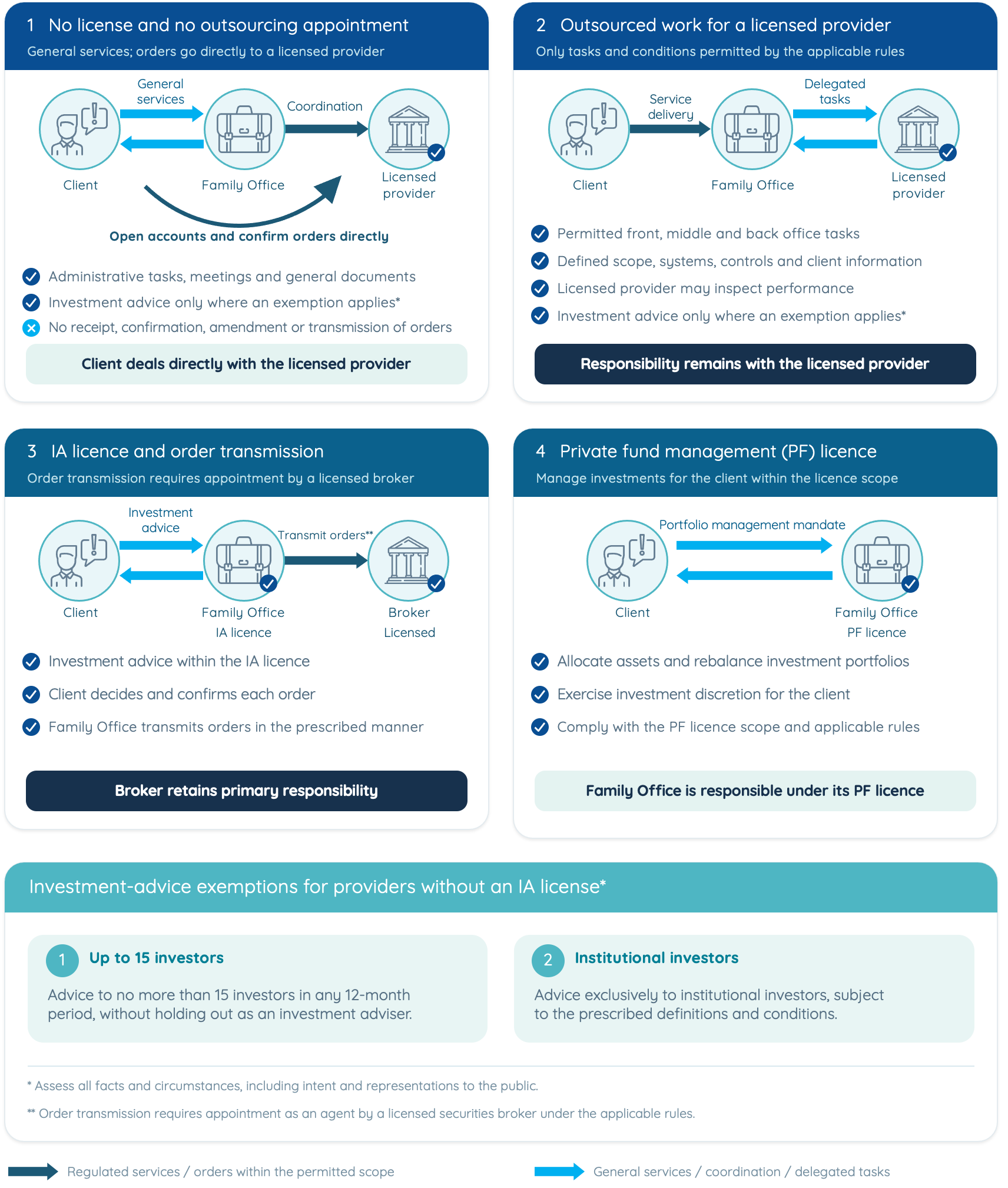
Figure. Family Office Service Models & Permitted Activities.
Commercial relationships also deserve close attention. The SEC’s guidance recognizes arrangements involving referral payments, revenue sharing and continuing service remuneration, subject to applicable rules. Fees should correspond to lawfully performed services, with appropriate disclosure of business relationships, compensation and potential conflicts. Families should understand who pays their advisers and how those arrangements may influence recommendations or product selection.
For families establishing an office, the practical starting point is an operating model that identifies the assets and persons served, the decisions retained by family members and the authority delegated to employees or external providers. Governance documents should explain how investment proposals are approved, how expenditure is authorized and how conflicts are escalated. Service agreements should describe each provider’s responsibilities, reporting obligations, fees and access to information. Periodic reviews become particularly valuable when an office begins serving additional families, introduces new services or receives broader investment powers.
Cross-border planning should proceed alongside this regulatory assessment. Advisers should examine the proposed entity structure, foreign-business permissions, tax residence, income flows, employment arrangements and information-sharing practices in the jurisdictions concerned. The analysis should connect the family’s commercial objectives with its actual management arrangements and documentary evidence. A structure designed around identifiable functions and accountable decision-makers will provide a stronger basis for implementation and continuing review.
In our view, the circular’s principal contribution is the clearer basis it provides for organizing private wealth services in Thailand. Families can use that clarity to determine the support they require, select appropriately qualified providers and establish governance arrangements suited to their circumstances. For service providers, it creates an opportunity to develop coordinated offerings supported by precise contractual responsibilities and a documented assessment of regulatory permissions.
Mahanakorn Partners Group advises international families, entrepreneurs and professional service providers on the legal, tax and governance considerations involved in establishing and operating family-office arrangements. Our multidisciplinary practice assists with corporate and ownership structures, succession planning, family governance, regulatory assessments and contractual arrangements with external providers. Working with clients’ investment professionals and overseas advisers, MPG develops coordinated arrangements that support the preservation, administration and transfer of family wealth across generations.